Friday, 26 February 2021

The Big Island

The thrill of arriving at a new destination by sea is usually superseded by the longing of three things, at least for us, especially when the passage takes weeks instead of days.  Our excitement by that time is already increased by hours, our watch schedules long abandoned for the first evidence of land.  So what we desire most of all, once the anchor is set, is some cellular service, a well deserved cocktail, and a full night’s sleep.  Often, we arrive in the wee hours after long voyages as we did this time in Okoe Bay on the Big Island of Hawaii, and thus wake up excited once more for the first real glimpse of our haven.

Always exciting to see where we landed!


These are our first images of the Big Island!

The sea bed looks very much like this shoreline of craggy lava rocks.

We woke that first morning pleased to find ourselves safe and well embedded in a stunning and somewhat deserted cove on the southwestern Hanamalo Point.  It was a landscape we had not yet encountered in our travels on india.  Wild and dramatic with black volcanic beaches and fierce surge breaking on outcrops of dark yet beautifully ominous volcanic outflow.  The swirling waters of intense blue ocean were mesmerizing and we spent time catching up on our rest and tidying the riot onboard incurred from the tumultuous passage.  A few days of quiet solitude was just what we needed before moving on to the full onslaught of civilization we knew awaited.

Images of pyroclastic flow on the shoreline.

More evidence of the power of nature!

The appropriately named Big Island is the youngest of the Hawaiian Islands formed from six volcanos working together and partially overlapping during the last million years and are responsible for some impressive world records.  Kilauea is the most active, Mauna Loa is the most massive active volcano and Mauna Kea is the tallest sea mountain.  What is particularly interesting about Hawaiian Volcanos is that they are formed on a slowly moving pacific plate over a stationary hotspot located beneath the present-day position of the Big Island of Hawaii.  In 2018, a new eruption of Kilauea changed the island forever when large lava flows destroyed over 700 homes and devastated residential areas in the southeastern Puna District.  The summit area of the volcanic national park was dramatically changed by thousands of earthquakes, towering ash plumes and a massive collapse of the Kilauea caldera.  I remember watching this event on television at home on the mainland wondering how anyone would be safe on an island erupting into a deadly and destructive ooze, but now I realize how enormous the island is.  The northern parts were only minimally affected.  It took us all afternoon to motor 30 miles up the coast to the port of Kona-Kailua because, as we were beginning to realize, Hawaii's anchorages are largely comprised of national parks, marine sanctuaries, swimming areas for grand resorts and fishing grounds or are primarily geared for small recreational vessels if they are at all protected from a dominating Pacific swell.  Which is why we found ourselves anchoring once again in darkness 6 hours later post sunset in unfamiliar territory since Kailua-Kona was our second Plan B for that day.  


Kona-Kailua Waterfront


Here we were able to process ourselves and our boat through Customs and Immigration the next morning which turned out to be relatively painless despite the Covid-19 Precautions.  We had notified authorities of our arrival in advance and our passage from the Marquesas provided adequate quarantine.  In a short time we were cleared and free to explore the town area which was festively decorated, Hawaiian style, for the Christmas Holidays.

Considering the distances, we rented a car for a few days and divided our tours into sections starting towards the northern points and taking the coastal road then inland through the peaks and valleys all the way to Kapa'au.  Our first stop on the way was the Kanaloa Octopus Farm at an aquaculture research facility on the west coast.  After a short introduction, we were escorted to a large wet lab containing about 30 tanks, each housing a single cephalopod because unless they are mating, they are hostile to one another.  We were invited to interact with these amazing creatures by putting our hands into the tanks and wiggling our fingers to attract their attention.  It is not every day that one shakes hands with an octopus!  I was surprised by their strength when they latched on and tasted us with every tiny suction cup!  They are curious, highly intelligent and adaptable to their changing environment.  We saw first hand how instantly and dramatically they change color indicating mood, an ability critical in camouflage for predator avoidance and hunting.  They are very playful and seemed to enjoy squirting us through their siphon, or breathing tube, and will grab a GoPro and disassemble it in seconds if you are not quicker than they are!  We will never forget our encounters with these other worldly and fascinating octopuses.  It was a rare treat indeed.


The northern parts were green and lush and covered in farmland.  We enjoyed driving through fields and then forests along good roads and delighted in the rise and fall of the landscape offering changing views at every summit and occasional small towns with a Hippie Vibe straight out of the 60s!  We stopped for some delicious Kona coffee and browsed around the local shops and paid homage to the statue of the very late Hawaiian King Kamehameha I, the founder and first ruler of the Kingdom of Hawaii.  It was one of our most favorite days.


Coffee break in the town of Hawi


The following day was spent primarily in the Hawai'i Volcano National Park which extends from sea level to 13,677 feet and encompasses two of the world's most active volcanoes - Kilauea and Mauna Loa.  Kilauea is the youngest of all six volcanoes and has been in an actively eruptive state since 1983.  The name Kilauea means "spewing" or "much spreading" in the Hawaiian language and this volcano certainly delivers!  We drove around as much as we could and stopped to walk around the observation points.  As it turned out, we were some of the last viewers of the crater lake before the Halema'uma'a caldera at the summit of Kilauea erupted on December 20, 2020 just two weeks later!  Lava is now feeding the ever growing lava lake from three fissures.  It is tempting to go back to see it again!


Windward Coastline

Hot Pot or Vent


Crater Lake

Closer View of Crater Lake


Ha'akulamanu Sulphur Banks


The greenest and most fertile part of the island is found along the Hilo and Hamakua Coasts, where tropical rainforests and botanical gardens can be found.  We knew we couldn’t visit all of the many waterfalls which require arduous but spectacular hikes.  So we chose Akaka Falls State Park for a reasonably accessible and time efficient walk through an absolute paradise of tropical vegetation and flowers.  As for a Botanical Garden, one can do no better than Queen Lili'uokalani Park with it's Japanese Gardens which we strolled through on a misty afternoon.  Hilo, another big town on Hawaii is a much older in age and in style than the resort-like Kailua-Kona and doesn't have the sunny beaches found on the other side.  It's a college town, with higher levels of rainfall and closer to the majestic waterfalls and hikes.  We found Hilo to be charming with great hole-in-the wall restaurants and retro-chic shopping and stopped for a bite a couple of times since the Costco, Lowes, Target and Walmart are also located there!  We never go back to the boat empty handed when we have a car!


We noticed from our very first cup here in Hawaii, how absolutely delicious the famous Kona Coffee is and we were excited to take a tour of a Coffee Farm.  Greenwell Farms is one of the largest and oldest, having a legacy since 1850 and a great founding story.  They were highly recommended and we found the tour incredibly interesting and informative.  We have been buying and enjoying coffee from the region ever since!


Although Hawaii was not in our original voyage plan when we set off from Panama last March, it has been an unexpected opportunity for us.  Surprisingly, neither David nor I have visited these beautiful islands before and being an American port gives us quite an advantage.  Most importantly, it gives us protection from the Southern Pacific Cyclone Zone but in addition, our cellular plan works perfectly here and we can easily receive packages and shipments from the mainland with no extra handling and custom charges.  As I mentioned before, the provisioning for the boat is excellent and we can reasonably upgrade a few interior items as well.  I will also admit that my impression of Hawaii heretofore has been totally unfounded.  Hawaii is far more exotic than I ever imagined with a rich history and culture.  The people here are uncommonly friendly contrary to opinions I had read and heard in the past.  Of course, there is not the usual amount of tourists here now due to Covid, so it is not crowded and overrun in that respect and the locals aren't overwhelmed.  So far the challenge has been in the logistics of where to anchor the boat and weather windows for the channels between islands.  But I think we can manage that.  So far, it has been a very pleasant experience and we are just getting started!  If you ever plan a trip here don’t miss out on what the Big Island has to offer.  It is the biggest of them all, and super laid back and starkly beautiful with many attractions to keep you busy.  We loved it here!


Wednesday, 13 January 2021

The Marquesas to Hawaii - what a ride!!!

After an incredible seven month sojourn in French Polynesia, the time had come to leave this South Pacific paradise and venture north to Hawaii.  This destination was not on our original plan, but with so few countries and islands west of French Polynesia open, and cyclone season now in full swing, it was the prudent move and would give us the chance to see a part of the US neither of us had visited before.  The passage from the Marquesas to Hawaii is around 2000 nautical miles on a heading of about NNW crossing the equator from summer to winter.  The trade winds, both north and south of the equator are largely from the east, south east below and more north east above the Inter Tropical Convergence Zone (ITCZ).  This means it should be possible to sail all the way on either a beam reach or worst case a close haul.

We had been watching the weather on the passage line for a couple of weeks, and had never really seen an unfavourable situation - the winds were as mentioned above, and around 15-25 knots more or less all the way. The passage time estimates were about 12-14 days. So having picked a departure date - Thursday 26th November - Thanksgiving Day in the US, we spent the last few days in Nuku Hiva on last minute provisioning, a tour of the island and boat checks and preparation.  It's wise to check all the lines and rigging before a passage so I found myself hoisted up the mast the day before leaving to check all was well.  Unexpectedly I found a couple of small issues that required some attention - there was a small line chafe close to the top of the main halyard which hoists the mainsail, and the aluminium extrusion which holds the Genoa sail had slipped again and caused the top swivel to dislodge at a weird angle.  The question was - do we try to correct these before leaving, or are they minor enough that we can wait until we arrive in Hawaii?  After much consideration of the risks and potential consequences, we decided to stay with the plan (and hope for the best!!).  8am on Thanksgiving Day saw us weighing anchor for the last time in French Polynesia as we slowly motored out of Tahoie bay towards the southern coast of Nuku Hiva.  We would make our way west along the southern coast and then north past the west end of the island to pick up the winds once clear of the island mass.  After a couple of hours, and exactly as expected, the easterly winds hit us with a vengeance and we were off!  The sun was shining, the sails were full and open sea ahead of us beckoned as we mentally prepared for the next two weeks at sea.  

Towards the end of the afternoon, as we were approaching the most northern and largely uninhabited islands of the Marquesas we heard the fishing line scream!  After a short but energetic fight we landed a beautiful Mahi-Mahi with its iridescent colours of blue and yellow flashing in the lowering sunlight.  This was the biggest Mahi we had landed yet, and it made enough delicate white flesh for six meals - a great start to our passage!  As we passed the northern islands and off into the great Pacific once more, we continued to make fast speeds with the wind consistently  blowing 20 knots on a close haul.  The moon was becoming full, which is a huge bonus on these longer passages as one can see much more at night and especially with bigger seas, it makes for a more comfortable ride.  That first night passed uneventfully and by 8am the next morning we found we had covered almost 200 miles, which is an average speed of 8 knots.  The following day, and subsequent four days, were the same - mostly sunny, 15-20 knots of wind on a beam or close haul and anywhere between 175 and 200 miles travelled.  We crossed the equator on day four, Sunday, and as always shared a tot with Neptune in the hope of securing safe passage for us and india.  During the afternoon we had enjoyed a huge pod of dolphins swimming with us, jumping and playing as if happy to see another soul in this remote ocean.  Shortly after they left the fishing line screamed again, and with a bang went quiet...I pulled the line in to find the whole lure and stainless steel leader had disappeared.  It could have been a large shark but we were hoping one of the dolphins hadn't mistakenly took the lure - it would be unusual as they are normally too clever for that.  Once when sailing in the Marquesas we had a not-so-smart booby who was following the boat take the lure and got the hook stuck in his beak.  Not at all what we want to catch!

The first of our two Mahi...


The moment we crossed the equator

We had used the Code zero sail on and off over these first few days if the wind dropped a little, and it proved again to be very effective in the right conditions.  On day five we had a slight issue when furling the Code zero as the wind picked up, when it tangled on itself and jammed in such a way that we knew it would be difficult to unfurl again.  When such things happen on a day trip or shorter passage, it's fine to wait until anchored to pull it down and do whatever is needed to resolve the jam, but when one is making relentless progress in big seas, everything becomes 10 times more difficult, and dangerous.  So with the waves breaking over the bows, I headed up front to drop the whole Code zero sail and torsion line onto the trampoline and try to figure out how to unjam it.  Well, it stayed like that overnight until the following morning when the wind again dropped enough for us to hoist it once more, and play around with alternately the sheets and the furler, back and forth, until at last the wind caught in the tangle and blew it free.  We were off again!  Little did we know these were the last days we would see our striking blue Code zero in all its glory...

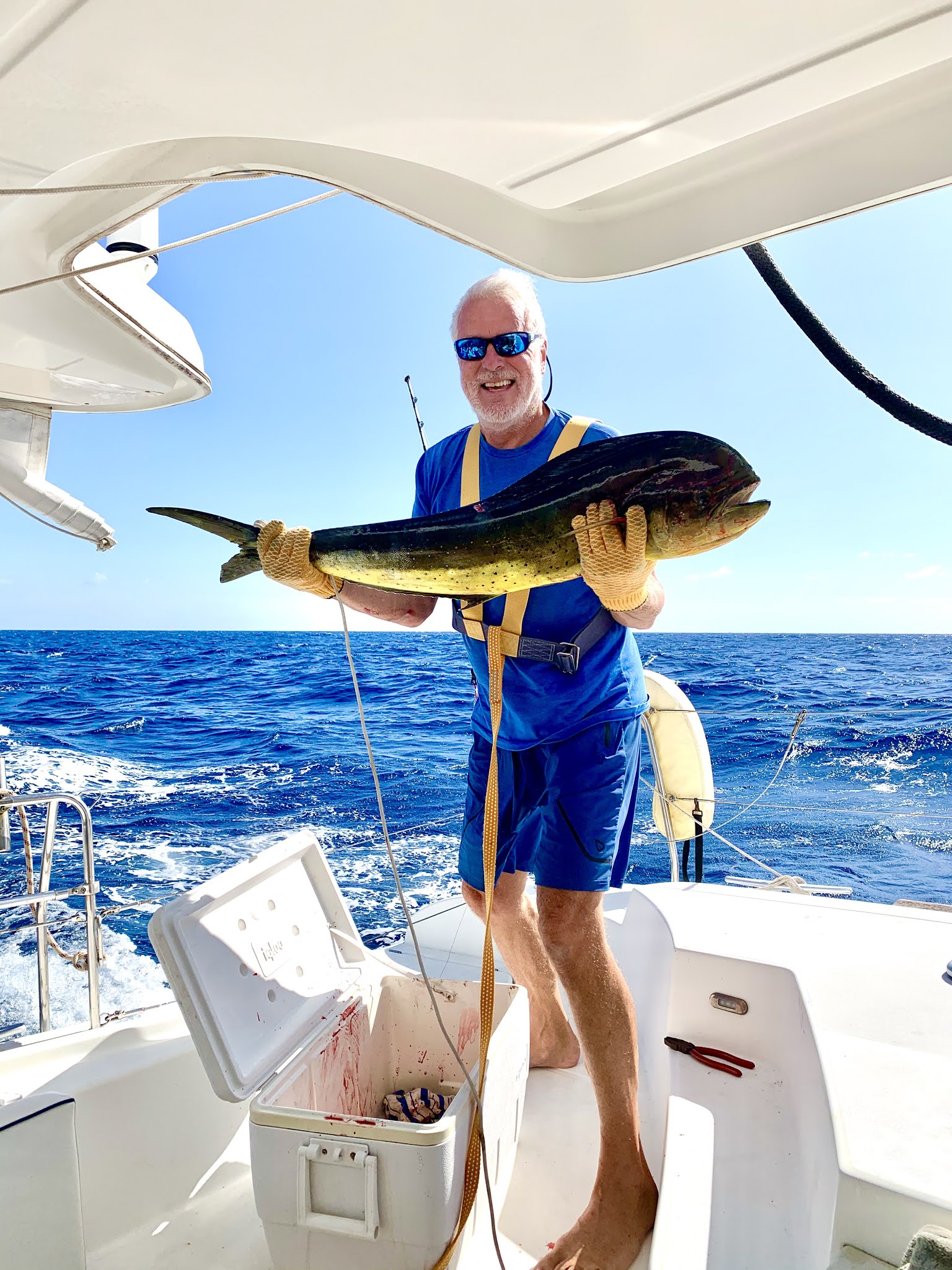
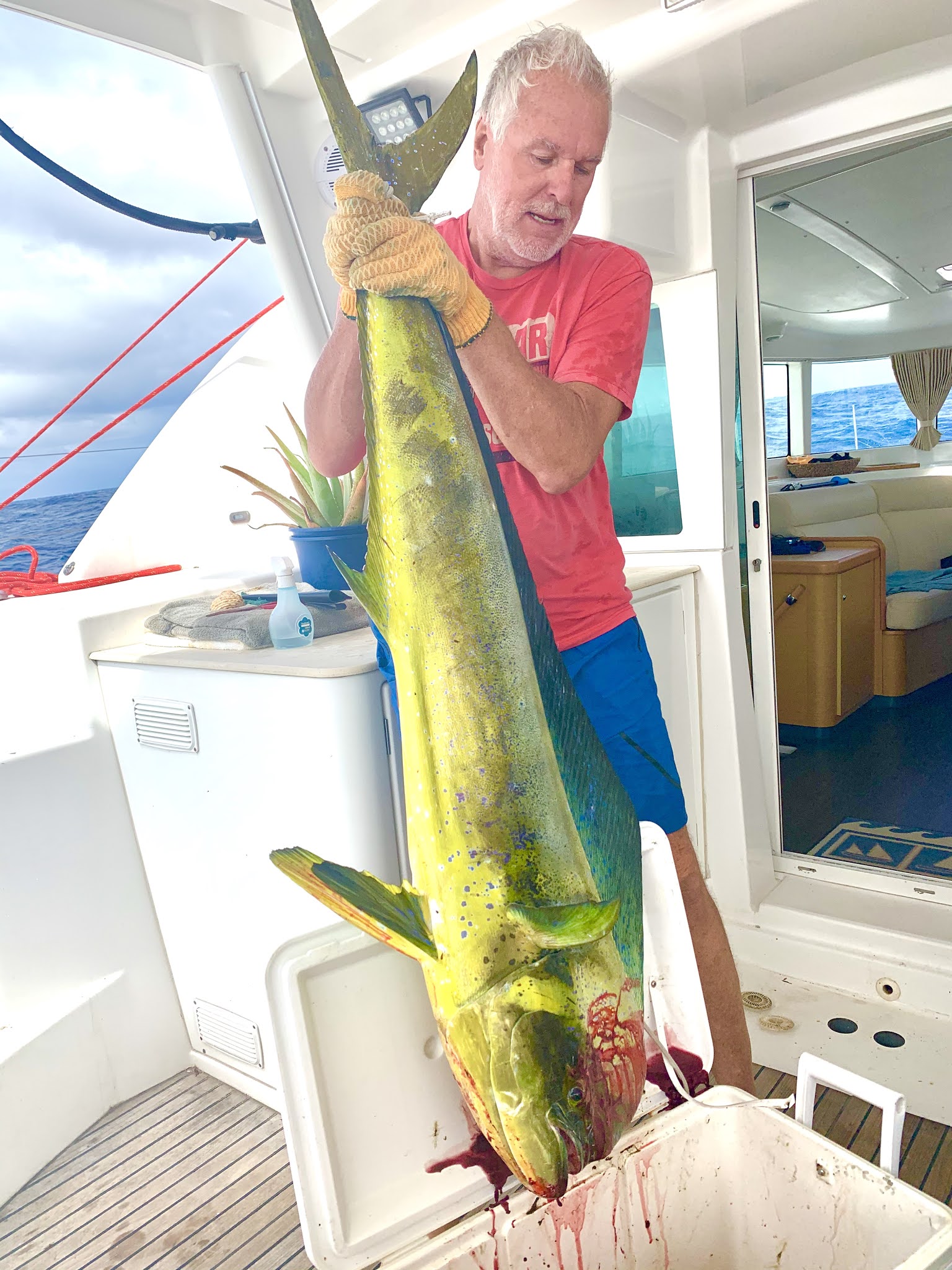
By day six we had still not quite reached the ITCZ, as it was sitting quite far north (around 5-6 degrees N) at these longitudes, and enjoyed our last day of comfort and leisurely sailing, as it transpired. Day seven, Wednesday, dawned with light winds and some small squalls.  We chose to fly the Code zero and luckily passed some squalls without major wind increase as the day drew on.  During the afternoon we again heard the fishing line scream, and as I started to reel in whatever surprise was hooked, I knew it was big, the pull was enormous.  These days we can usually tell by the behaviour of the catch what it is before we see it. Tuna tend to dive down deep and pull all the way, they are super strong. Wahoo stay near the surface and don't fight much as you reel them in.  Mahi-Mahi also stay on the surface and you may or may not get a glimpse of their vivid colours as they jump and squirm. Ten minutes of quite a fight, and then close to the boat it jumped a little and we could see it was a huge Mahi.  Right up close as we are preparing to gaff the fish, we start to execute the plan - harness for me, attached to the lifeline, I step down the rear steps to be close to the water, Dara hands me the gaff and I try to gaff the fish before it comes to life and wriggles free.  We have lost so many huge fish in these final stages as we perfected our technique, but this was not about to be the one that got away!  Sure enough it may have been the largest Mahi we had seen, a huge bull (male with the large protruding 'forehead').  It was so big I could barely lift it up for a photo, but it was easily almost five feet long and more than 60 lbs.  It made ten more delicious meals, straight into the freezer.

Monster Mahi!

As dusk fell and the last vestiges of sunlight disappeared in the east, we saw what appeared to be a large squall on the horizon ahead of us.  We were still flying the code zero, and had passed through one or two smaller squalls without significant wind increase during the day, so were hopeful this was the same.  Within what seemed like only minutes, the squall was upon us, and it suddenly became dark all around, the rain started falling and the wind increased.  We knew right then it was a mistake to have left the Code zero up for the night, and as went on deck to consider it, we arrived just in time to see the huge sail explode in a tickertape of blue nylon as the wind hit 30 knots.  Nothing to do except secure the remnants of the sail and turn on the engines.  Luckily with no other sails up, we were able to weather the storm as the seas and wind built over the next two hours.  You probably haven't really sailed until you have spent time in the pitch black darkness, thousands of miles from anywhere, being tossed around in 12 foot seas and 40 knot winds, with little control over the boat, for a couple of hours.  This storm (way more than a squall) seemed to follow us as we tried to make some progress north away from it.  the ITCZ is either deadly calm - the doldrums - or frighteningly stormy, so we knew we were in for a long night.  Also we knew the 'zone' stretched at least 150 miles north of us, so we likely had 24 hours of this to look forward to.  As it happened, that big first storm was the worst of it, and after we had come through that, we had only some rough seas and more heavy squalls to worry about.  By day break it all looked better anyway and we continued motoring northwards, hoping to pick up the northern hemisphere weather system of NE trade winds soon.  Slowly but surely, conditions improved and by nightfall, 24 hours after that big storm, we started to feel the steadily increasing NE winds. I have to say, india, as always, proved a worthy adversary for the conditions and not once did we feel unsafe or in any danger.

And so the trade winds had thankfully arrived, but be careful what you ask for.  We were now 800 miles from Hawaii, and these winds would be the predominant conditions all the way there.  Our weather predictions had forecast 15-20 knot winds, but these were 20 knot +, and right at a close haul wind angle, which usually is our fastest point of sail.  That meant we were moving at quite a rate of speed, anywhere between 8 and 10 knots, often more, together with 9 feet waves coming at a 45 degree angle to our heading.  All this makes for a thrilling and uncomfortable ride.  We have all been in an uncomfortable travel situation at some time or another - a cramped airplane seat, a rough road in a car, but the thing about this ride was that it is seemingly endless, and one can never take a break from the relentless noise of the wind, the boat, the crashing sea, and the extreme exaggerated movement.  So this went on for four days and four nights, never really letting up, and even becoming worse at times.  The only saving grace was that we were making incredible speeds and eating up the miles. On the second day of this leg, we made 217 miles in a 24 hour period which is an all time record for us - an average speed of over nine knots hour after hour after hour. That was made even more remarkable by the fact that we had a breakage right at sunrise. Even though we had one reef in the mainsail to control the load on the sail and rig with these higher winds, a gust from a dawn squall blew out the reef line and caused the sail to destroy the port lazy jack lines, which come down from the mast spreaders to hold up the sail bag and also guide the main sail down into the bag when lowering the sail. This meant the sail was billowing inefficiently and also the sail bag was hanging down from the boom with broken lines everywhere.  It was quite the wake up call for me to climb up in the winds, and attach manual reef lines through the sail reef points and temporarily tie up the sail bag to the spinnaker halyard.  This manual fix needed to strong for the remainder of the passage, given the winds we expected right through to landfall.  

Simple metal doesn't stand a chance against the pressure of the wind..the block on our mainsail reef...

Another Beautiful sunset thousands of mile from anywhere...

Each of the remaining four days we covered at or above 200 miles, so it was no surprise that we found ourselves approaching Hawaiian waters after only 11 full days at sea.  Feeling a little weary of the constant buffeting, we peered towards the horizon on that twelfth afternoon, hoping to catch sight of the Big Island of Hawaii, knowing that it had huge volcanic peaks and should be visible quite a few miles out.  But oddly, maybe because of the haze, the low clouds covering the peaks, or the topology of the island with its sweeping plains from the peak to the coast, we never saw a thing.  After all this we were robbed of our chance to shout 'Land Ho!!' - that quintessential sailor's shout that has rung out over centuries.  We found ourselves questioning our navigation, checking the charts and the GPS, and it was really only when we noticed our cell phones had picked up a cell signal, did we really believe the island was there at all.  It was dark as we came closer and closer and eventually picked up the friendly lights of habitation in the distance.  We proceeded around the southern tip of the Big Island, the lights becoming brighter, until at last the seas started to become calm and we made a track towards our landfall anchorage.  As we have done on several occasions now, we slowly approached land, watching carefully the electronic charts, satellite overlays and depth data until we were in about 30 feet of water, about 150 yards from the shoreline.  All we could see were the lights of the many small fishing boats plying their trade at night, and probably wondering who these idiots were trying to manoeuvre so close to land in the middle of the night!  After 11 days 18 hours, we had arrived, the anchor safely hooked in Hawaiian seabed.  What a ride!!!


Thursday, 31 December 2020

Epilogue 2020


 Taha'a

Continuing the tradition we started last year, we present to you our Epilogue 2020, where we venture to answer some questions and reflect on our year’s experiences, while hopefully giving some insight on what we’ve learned and how we want to continue the adventure into next year.  What makes 2020 so incredibly interesting is that it didn’t turn out as intended for any of us.  We have all needed to adapt, adjust and modify our plans in some very unusual ways.   Just this morning while walking around the shopping epicenter of Lahaina, newly opened to tourism and freshly populated with bright and colorfully masked families all doing regular activities in a highly irregular way, I remarked at how astonishing this new world of social distancing still seems to us, as we have largely avoided touristed areas until now.  And it reminded me also, how we saw a glimpse of this surreal world watching Asian travelers in India, the sub-continent, merely a few years ago, who always seemed to be wearing masks.


Reflecting back to this time last year, S/V india was freshly launched from the Varadero Boatyard on the popular Dutch Island of Aruba to its adjacent Marina.  David and I had celebrated our holidays earlier in December by traveling to the U.K. to meet our new granddaughter, Clarissa and new grandson, Rupert, and to spend time with our family there before stopping in Charleston to visit family and friends on our return.  How truly thankful we are, especially in retrospect, that we could spend that special time together.  We spent our actual Christmas covered in bottom paint and dust in the shipyard preparing india for our Pacific Passage in what looks to be an annual haul-out and check up that we’ve learned pays dividends in safety and minimizing maintenance and potential problems later.  We returned our catamaran to optimum condition and readiness in time to celebrate New Years with champagne and fireworks, the excitement for our forthcoming expeditions barely contained and our next destination Cartagena! Colombia!


Veradero Boatyard on New Years Eve 2019


Our exhilarating coastal sailing in Colombia and Panama is still spine-tingling and brings a fresh excitement to memory every time we think of it.  The extraordinary confluence of old and new in the enchanting city of Cartagena left us wanting so much more and vowing to return.  The moment we laid eyes on the Puente Atlantico in Colon, knowing that our eminent Panama Canal crossing had finally arrived was the fulfillment of a lifetime dream.  It was all so exciting and long awaited as the whole of 2019 was preparation for this moment.  We reserved our canal passage for 02-20-2020, as an auspicious date, and explored the obscure but friendly San Blas Islands while waiting for our line handlers and friends Andrea, Kalev, Angela and Rick to arrive.  As it turns out, they are the first and ONLY guests we’ve had stay aboard india in all this time.  Following some downtime in Las Perlas after the excitement of the Panama Canal, we returned to Panama City to make the final provisions for the Pacific Passage.  It was mid-March and when the WHO declared a Global Pandemic of Covid-19, we were in mid provision.  Choices were grinding to a halt and ours was to ramp up preparations and head to sea.  The most frightening aspect of the situation was that no one really knew the truth of the Pandemic.  Facts were elusive but anxiety and concern was rampant.  David and I felt that we were making the right choice in an immediate exodus and quarantine at sea and have the benefit of knowing that it was the right one now that it has clearly worked out very well for us.  But our departure into the unknown with limited contact and information from the outside world was an eerie and surreal 30 plus days coinciding with an epic sea adventure.  And we had no idea what we would find on the other side.


Cartagena!


Our favorite restaurant!


San Blas with a background of Panama


San Blas Islanders


Puente Atlantico


Our Motley Crew


Our first contact with another human came in the form of the young French Gendarmes we encountered on an illegal first landfall in the Tuamotos.  Their friendliness and reassurance did wonders for our moral because moments of trepidation concerning the pandemic had shadowed the celebration of our ambitious undertaking and joy of arrival.  From that moment onwards we felt embraced by the welcoming culture of Polynesia and awed by the sheer magnificence of beauty these multifaceted islands and atolls possess.  Enticed by the fragrance and fantastical notions of Tahiti we set forth to explore as countless seafarers before us have done.  We have wondered to what extent our cheerful and jubilant posts and blogs have annoyed our readers during these times of discontent, but concluded that maybe some good news and pretty pictures would be welcome respite from the continuing insanity of 2020.  Besides, these incredibly remote locations so dazzling in exquisite and breathtaking views practically demand to be shared and our ultimate goal in preserving our experience is for remembrance so we can enjoy them in our later years.  We do hope that you have enjoyed them along with us this year.


To summarize French Polynesia is not only difficult, but impossible, and again, our memories are available for us to review at any time.  So let me just reiterate how truly grateful we are to have had such an unimaginable seven months to immerse ourselves in an absolute paradise on earth.  It was more than double the amount of time we initially envisioned which allowed us to traverse a greater area than we would have done originally and doing anything less seems impossible to us now.  In fact, we have only seen a mere modicum of what French Polynesia has to offer and would do it all again and then some given the time.  It is hard to convey the vastness of this entire area.  That it takes days to travel from one archipelago to another provides some indication.  There is so much to see making choices difficult knowing one cannot ever see it all, but we are content that we experienced a great variety and cross section and wouldn’t trade the uniqueness of our personal voyages.  The unprecedented days that unfolded the Society Islands absent of tourism was an encounter unparalleled in modern times and truly a highlight due entirely to the pandemic.  But benefits often have a cost and the downside was that our contact and therefore our connection to the inhabitants was limited.  We regretfully did not interact with the Polynesians as we would have liked and as closely as we interacted with other communities in our past travels, especially India, the Sub-continent, which enhanced our knowledge and familiarity in untold proportions.  It was easier to be friendly in the more remote Tuamotos and the Marquesas and the natives we encountered infused our exploration with great personality and Joie de Vivre, entwining Polynesian hospitality with French flair.  It was a privilege to share in the pristine beauty of these sparsely populated outcrops.  The raw and untouched terrains and translucent waters teeming with colorful and tremendous aquatic life was a perquisite opportunity.  We have been honored.


Faa'a Anchorage in Tahiti with the backdrop of Mo'orea

Almost all of the Pacific Islands to the west of us have barricaded themselves against the pandemic by remaining closed to tourism and understandingly sealed their borders to protect a vulnerable citizenry.  It is somewhat easier to contain the virus on island nations with the ability to control immigration.  Since most of these nations benefit enormously from hospitality industries, it will be interesting to see what they decide for the 2021 season.  French Polynesia had only a handful of active cases and no deaths when they opened their borders to international flights on July 15th and they reached 16,696 cases and 113 deaths by Dec 28th.  Fiji opened its borders to cruising yachts by the end of summer.  To go there would have meant we would bypass many of the places we wanted to visit with an additional downside of not having an escape for cyclone season since New Zealand and Australia, which are outside the zone, have kept their borders closed as well.  By August we were decided on a detour to Hawaii for ourselves, since we had the American Option, and it has turned out to be a blessing in many ways.  Foremost, the Hawaiian Islands are beautiful, friendly and full of First World convenience, and unfortunately, those yachts choosing to sail to Fiji have just been hit by a Cat 5 Cyclone.


This brings us to a couple of questions we are asked such as what are our plans now and where will we go?  To answer; Our immediate plans are to be in Honululu by late January for our now annual haul-out.  We have a few items to attend below the waterline and will reapply coats of bottom paint while we’re at it.  India will need a good spring cleaning following that and we will be well positioned to continue our tour of the Hawaiian Islands and sail south again, eventually flipping hemispheres for re-entry to the South Pacific.  Our destinations will be contingent upon what countries become available to us for travel and whether we will be able to exit the cyclone zones in New Zealand or Australia next fall.  That would put us somewhat back on our original course, but only time and successful management of the Pandemic will tell.  We have discussed a route through Japan and Guam but it is a circumventer in opposition to favorable winds near the equator and now that Japan has increased its case load of infections it is less likely to happen.  So the simple answer is to carry on enjoying each day, as we have learned, and embrace the opportunities that present themselves as more information comes to light.


If we were to take a stab at the highlights of the year 2020, it would surely include all of the amazing sailing we have experienced on our india this year.  We have covered over 10,000 Nautical Miles in two oceans and both hemispheres crossing the equator twice.  We have have sailed in conditions just exciting enough to keep us on our toes, but thankfully have not encountered any life threatening storms this year.  We have met some super nice cruising sailors, such as ourselves, along the way and have enjoyed pleasant excursions and many meals and cocktails together.  We have parted ways and headed to the four winds but still keep in touch exchanging valuable information while following along on other’s journeys with great delight.  The incredible interactions with sea life is also high on our list.  From the tiniest playful reef fish to the menacing sharks, the graceful and mesmerizing Mantas and frolicking dolphins ever eager to keep us company at sea, to the colossal humpback whales; this year has been and unimaginable parade and we have been enthusiastic spectators.  As for the rest…we will let the photos speak for themselves.


We wish all of our friends and family a hopeful and prosperous and most importantly, a safe, New Year!


Devil Rays in Bora-Bra


Snorkeling in Taha'a


Maupiti


David with the Mantas


Heiva


Our spot at Tiputa Pass, Rangiroa


Beautiful Lagoons within a Lagoon at Rangiroa

Tetamanu at the South Pass in Fakarava


Sharks in Tahanea


Alone in Raroia


Hanavave in Fatu-Hiva


Dramatic Nuku-Hiva


Our biggest catch yet!

One of many incredible sunsets